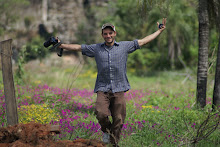
A quick update as as I head into the home stretch.
I am currently about 400 km west of Agra and the Taj Mahal in the sacred Hindu city of Pushkar, Rajasthan. I can already feel the energy and pull of the Taj and that great feeling of being Done.
As I see it, I have 3-4 days of riding left and the plan is to make them count. It is a straight shot from here on out via national highway 11 and national highway 8. After 6 weeks and thousands of kilometers, my bike, much like my life (just kidding), is in varying states of disrepair. The brakes, the wheels, the tubes. the spokes- there all there and trying to fall off. The only thing that hasn't given me trouble, thank the good Lord above and all 330 million Hindu Gods, is my dear seat. A true saddle of relative comfort of first class travel.
No, I jest, without a doubt this bicycle wasn't designed to go across the Indian subcontinent in one glorious streak of fire but it has indeed proved its mettle (every last piece of it). In a certain sense, this trip as been about being "Just Enough." The bike, the distances in between cities, my physical ability, the terrain, Indian hospitality. It all has been "just enough to make this trip happen." That beautiful balance of going for it all, holding nothing back, and catching a couple of timely breaks and twists of fortunes along the way.
Two quick stories- About a week ago, I arrived in Sasan Gir National Park. The last remaining home and stronghold of the Asiatic Lion. Yeah, they still do exist but only in this small corner of Gujarat in western India after once roaming freely throughout the subcontinent and west into Persia. I arrived in the evening and was reading the information presented in the Orientation Center. There I met a park guard who had 2 uncles just come to visit him. Initial conversation led to an invitation to dinner at his home in the village close to the park. Hungry after a days ride and intrigued to experience "authentic India" I accepted. (It is one of those things where you have to use your spider senses- go with your gut and feel out the situation and whether or not to accept).
However, as Indians eat dinner around 8 pm, I didn't know where I was going to sleep that night. The park guard, my new friend, Bavesh, cheerfully said I could sleep at his house. His face became a little apprehensive however as he realized that his family shared a one room mud thatched roof house with no running water and no electricity. No bother- sounds like the Peace Corps- sounds like fun. I ended up spending 2 nights there, sleeping outside under the stars, eating like a king in a pauper's abode, the rich spices and family conversation far outstripping the want of subsistence poverty and tracking Asiatic lions on forest safaris. Alas, no sightings but we were in hot pursuit of lioness for about an hour or two. in hind sight, what the hell was I going to do if in fact we had seen. It's paw prints were twice the size of my fist.
As I was riding through the desert a week back, I stopped under the only tree for miles around to catch a breath and a bit of shade. There was a man there selling chai tea and upon seeing me, told me to leave my bike and jump on his motorcycle. He was taking me to eat lunch with his family. A couple of turns along a dirt road and a past an ancient and forgotten centuries old castle we were in his modest home sharing a meal of rice, unleavened bread and spicy hot dahl. His mother, a women in her 60's said (in Gujarati and translated into English)- "you know, its not right you traveling by bicycle."
I smiled between bites and quickly shot back: "Absolutely, but if I wasnt on a bike, I wouldnt have had the opportunity to meet you and come to know of the town of Vithalgadh." She laughed and nodded her head in a mix of agreement and wisdom. "Next time," she said, "take the bus." Sound advice and I told her that I would be back with friends.
Sunday, May 20, 2007
Monday, May 15, 2006
Post-Hurricane Stan Disaster Preparedness: Guatemala, 2006
Whereas one’s Peace Corps experience is an extremely decelerated process emphasizing the fundamentals of building community relationships, a Crisis Corps experience has a more heightened, task oriented feel to it. In effect, the Crisis Corps is the ultimate extension of resource identification and allocation: matching the linguistic and technical skill sets of returned Peace Corps volunteers with individuals, communities and countries that need them most.
Like the Peace Corps, the Crisis Corps is a statement by America, that we as Americans are present, both in times of joy as well as times of sadness, in the lives of our fellow human beings. Through our service, we are able to put a human face, touch, and character to the intangible tenets which make up the United States of America.
I am currently serving as an agroforestry Crisis Corps volunteer in the town of Tacana, San Marcos which is located 50 km south of the Mexican border in the southwestern highlands of Guatemala. I help to coordinate the reforestation efforts of the NGO CARE Guatemala and the local Tacana Forestry Office in a dozen rural communities hardest hit by Hurricane Stan.
Stan’s week long rainy presence over this remote mountainous region during the first week in October 2005 caused massive and widespread mudslides that destroyed houses, water systems, roads and bridges and turned countless hectares of arable land into a waste land of rocks and debris. Working along side two other Crisis Corps volunteers, civil engineer Ken Kartchner and live stock specialist Wayne Winzer, as well as resident Agroforestry Peace Corps volunteer Eric Black, our multidisciplinary team has been able to address some of the more pressing concerns of post hurricane recovery: bringing potable water systems back on line, increasing food security through small scale chicken and pig projects and land recuperation through the establishment of agroforestry systems.
Throughout the last three months I have found myself in the fortunate position of being able to provide meaningful technical support while sharing in the daily lives of rural community members as they summon the strength to pick up the pieces of their shattered lives and move forward with hope and purpose. To put it simply it is a sight to see and a lesson to be learned by all of us.
“As always in one’s Peace Corps experience, Crisis Corps experience and the experience of life overall, the learning curve is steep but the return on investment is more than fulfilling if one is keen enough to realize which currencies are of true value.
As they say: Life is an everyday affair.
Like the Peace Corps, the Crisis Corps is a statement by America, that we as Americans are present, both in times of joy as well as times of sadness, in the lives of our fellow human beings. Through our service, we are able to put a human face, touch, and character to the intangible tenets which make up the United States of America.
I am currently serving as an agroforestry Crisis Corps volunteer in the town of Tacana, San Marcos which is located 50 km south of the Mexican border in the southwestern highlands of Guatemala. I help to coordinate the reforestation efforts of the NGO CARE Guatemala and the local Tacana Forestry Office in a dozen rural communities hardest hit by Hurricane Stan.
Stan’s week long rainy presence over this remote mountainous region during the first week in October 2005 caused massive and widespread mudslides that destroyed houses, water systems, roads and bridges and turned countless hectares of arable land into a waste land of rocks and debris. Working along side two other Crisis Corps volunteers, civil engineer Ken Kartchner and live stock specialist Wayne Winzer, as well as resident Agroforestry Peace Corps volunteer Eric Black, our multidisciplinary team has been able to address some of the more pressing concerns of post hurricane recovery: bringing potable water systems back on line, increasing food security through small scale chicken and pig projects and land recuperation through the establishment of agroforestry systems.
Throughout the last three months I have found myself in the fortunate position of being able to provide meaningful technical support while sharing in the daily lives of rural community members as they summon the strength to pick up the pieces of their shattered lives and move forward with hope and purpose. To put it simply it is a sight to see and a lesson to be learned by all of us.
“As always in one’s Peace Corps experience, Crisis Corps experience and the experience of life overall, the learning curve is steep but the return on investment is more than fulfilling if one is keen enough to realize which currencies are of true value.
As they say: Life is an everyday affair.

Subscribe to:
Posts (Atom)