Tuesday, April 10, 2012
Sunday, February 12, 2012
Canal Correspondence
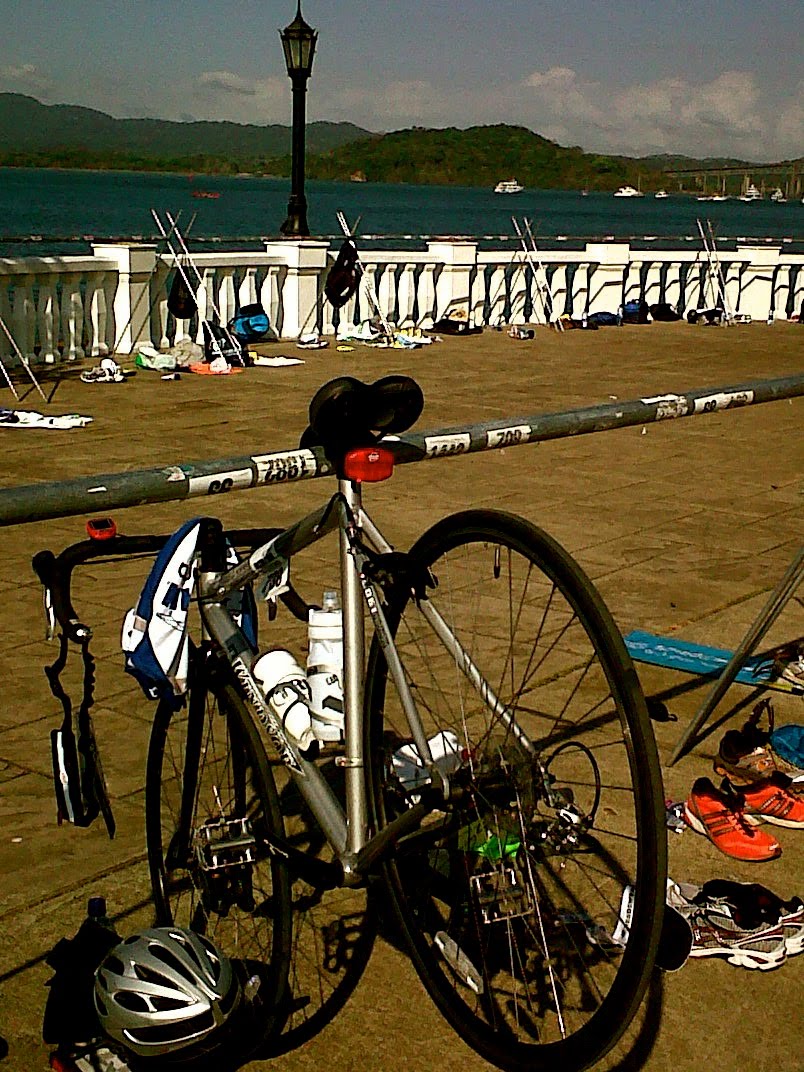


The Panama Canal has cut through the Central American isthmus and connected the Caribbean and Pacific Ocean for a century. This morning a small cadre of dedicated athletes swam through it, biked over it and ran along side it.
In hosting its first ever ‘half ironman’ -a 1.2 mile swim, 59 mile bike, and 13.1 mile run— the City of Panama turned over this iconic venue –a sea level canal framed by the juxtaposition of jungle covered hills and gleaming skyscrapers— to top flight triathletes and endurance amateurs alike.
As cargo ships steamed north toward the Miraflores Locks, swimmers’ arms rose and fell with disciplined cadence in the canal’s current as they entered the Pacific. Transforming themselves into cyclists, the triathletes rode over the Bridge of the Americas –the first bridge to span the canal– for a thirty-mile there and back. Trading wheels once more for pure human locomotion, the triathletes ran the remainder of the race on a ribbon thin causeway constructed from the canal’s excavation.
One Lance Armstrong –seven time winner of the Tour de France and cancer survivor- graced the race with his presence; immediately granting the inaugural competition with prestige and worldwide recognition. With the carriage of a Greek god, Armstrong held the lead until the final moments when a New Zealand competitor bested him.
Panama, home to three million inhabitants stuck to a jungle green landmass shaped like a stick of gum, is stretched by contradiction and cultural complexity. Boasting a $5.25 billion dollar canal amplification project for a waterway that generates millions of dollars in weekly revenue and a highly developed financial sector, Panama still harbors a subsistence farming, lack of potable water poverty rate of ~15%. In addition, expanding American Baby Boomers’ beachfront enclaves now but up against autonomous indigenous regions of the Ngabe Bugle, Kuna Yala, Wounaan and Embera who have managed to maintain their distinctive, centuries old cultural traditions.
Much like the efforts of any triathlete. Investment in expensive, technologically advanced equipment (feather weight shoes, carbon fiber bikes, enlarged canal locks) can only take Panama’s social and economic development so far. It is only the huge human component which makes success achievable: the hours of countless physical training, the extraordinary effort needed to execute community level capacity building programs.
The original fitness guru Jake Lalane is famous for saying: “Train for life as if it were an Olympic event.” Today’s triathletes epitomized this statement. Panama's development efforts should take note. Hosting its first half ironman is a good start, but completing the competition and improving the quality of life of its citizens is a whole different challenge.

Monday, December 5, 2011
In Pursuit of Peace: Mark it on your Calendar
The following photos were selected to grace the cover and the month of March in the 2012 Returned Peace Corps Volunteers International Calendar.
Please click here to view the entire calendar.

PANAMA
The beans, handpicked and slow roasted, are taken from the fire and set in a large wooden bowl to cool. The inescapable aroma of coffee permeates the highlands of tropical Panama. Served strong, dark and sweet, coffee is more than a hot beverage to get the morning started. Offered to all visitors, it is a mark of hospitality, an invitation for intimacy, and the Jimenez family brews an impeccable cup. Here Kayme picks through the cooling beans, adding anise leaves, snatching up the best ones to pop in her mouth. Soon, the beans will be ground, pressed, and shared by all.

MOLDOVA
The afternoon silence is torn by the rolling thunder of wheel on rail as the train trundles into the station in Chisinau, Moldova, the capital of Europe’s poorest country. The locomotive chokes to a stop, towering over the central platform. Patient, a woman waits as the hiss of the diesel engine fades to silence and stillness reclaims the afternoon. Deliberate, she stands and walks purposefully to the train’s door. Slow. Steady. She grabs the handrail, steps up, and boards the train. All are aboard, waiting to depart.
Please click here to view the entire calendar.

PANAMA
The beans, handpicked and slow roasted, are taken from the fire and set in a large wooden bowl to cool. The inescapable aroma of coffee permeates the highlands of tropical Panama. Served strong, dark and sweet, coffee is more than a hot beverage to get the morning started. Offered to all visitors, it is a mark of hospitality, an invitation for intimacy, and the Jimenez family brews an impeccable cup. Here Kayme picks through the cooling beans, adding anise leaves, snatching up the best ones to pop in her mouth. Soon, the beans will be ground, pressed, and shared by all.

MOLDOVA
The afternoon silence is torn by the rolling thunder of wheel on rail as the train trundles into the station in Chisinau, Moldova, the capital of Europe’s poorest country. The locomotive chokes to a stop, towering over the central platform. Patient, a woman waits as the hiss of the diesel engine fades to silence and stillness reclaims the afternoon. Deliberate, she stands and walks purposefully to the train’s door. Slow. Steady. She grabs the handrail, steps up, and boards the train. All are aboard, waiting to depart.
Sunday, November 13, 2011
Cerro Mbatovi: Balcony of the Gods


Loosely translated from Guarani as "The Balcony of the Gods," Cerro Mbatovi rises abruptly out of the grasslands of the Department of Paraguari. A solitary rock massif, Cerro Mbatovi represents the newest locale of a nascent rock climbing scene in Paraguay.
The summit approach requires an arduous bushwack through jungle underbrush and a hard rock scramble above tree line. Untouched and unclimbed, Cerro Mbatovi offers a rock climber's dream: a wall of first ascents. Currently being explored via top ropes and "bee veil rappels" (for red jungle wasp control) to develop potential rock climbing routes, Cerro Mbatovi's climbing future remains to be written.
Here is a link to the first article about rock climbing in Paraguay published on Rock and Ice, an international rock climbing magazine.
Saturday, November 12, 2011
Paraguayan Primavera


To the northern hemisphere's autumnal transformation, the southlands respond with a brillant flash of primaveral pastel. Here the Tajy Say'ju (the Lapacho Amarillo), a native tree to Paraguay, shines brightly in the church plaza of the pueblo of Guarambare.
Wednesday, February 16, 2011
Ice Climbing: Water + Cold + Gravity + Determination

H—O—H.
There it is. This naturally occurring simple sequence is absolutely fundamental to life’s existence. H20. A single oxygen atom covalently (sharing of electrons) bonded to two hydrogen atoms. By all accounts the bond of this crystalline formation is a weak one. What water lacks in bonding strength however, it makes up for in structural stability.
Drop the ambient temperature to zero degrees centigrade and a molecule of H—O—H actually expands— the only known non-metallic substance to do so upon freezing— to form transparent or opaque bluish-white hexagonal crystals. A solid state which is peculiarly less dense than its liquid counterpart.
This process happens daily in the safe confines of your freezer. The ice cube tray is cracked and emptied. An ice-cold beverage is enjoyed. The tap is turned on. The tray refilled and placed delicately back in the freezer. This great transformation from liquid to solid has been tamed for our own consumptive pleasure.
Water into ice. This process also happens daily in the winter wilderness of the great outdoors. Snow melts, water seeps down rock faces, waterfalls flow over cliffs. There comes a point however when the temperature freezes and all motion stops. Running water solidifies in midair.
Brilliant in their hues of blue and white, these ice formations tower above the forest floor like silent sentinels over the winter landscape. From below the view is breathtaking. From the top it is commanding. Stack enough ice cubes on top of one another and suddenly there is a mountain to climb.
On Sunday February 13th, ten New School students, aided by the professional guiding service High-Xposure, donned crampons and helmets, harnessed in and roped up, grabbed a pair of ice picks and climbed their way up 30 feet of sheer ice.
Water’s hydrogen bonds are weak but ice’s overall structure is strong. Strong enough to drive an ice pick through and hold your body weight as you dig your metal spiked boots in and pull yourself up.
Gravity exerts a constant downward force. Determination, if you choose an ever increasing upward one. The sun gleams off the frozen surface, you grit your teeth and smile….
Think of this the next time you reach for an ice-cold beverage…..
New School Recreation Outdoor Education: Leave The Library. Escape The City. Learn For A Lifetime. What Does Your Facebook Status Say…..?
SKI TRIP FEB 25-27. WHITEWATER RAFTING APRIL 16-17. ROCK CLIMBING MAY 7.
Thursday, January 20, 2011
A Journey Of A Thousand Miles Begins With A Single Step.


This statement is as practical as it is profound.
Upon graduation from Georgetown University nearly a decade ago, I embarked on my own journey of a thousand miles. Conscious of the fact that my first steps after college would shape my professional and personal life far into the future; I decided to serve as a Peace Corps Volunteer. Having been afforded every opportunity to learn, to live and to love; I was determined to live my life in the service of others.
Ten years, three Peace Corps Services –Paraguay, Guatemala, Panama— and multiple languages later, service remains the focal point of my life’s journey. My most recent personal step however, has forced me to recalculate where in fact, my journey truly began. It wasn’t the Peace Corps or Georgetown University but rather on 87 Halsey Avenue at Saint Cecilia School.
Returning to Panama in early January to give my Peace Corps Community –El Entradero— a surprise visit after a two and a half year absence, I had a homecoming far greater than expected. Upon arrival in El Entradero –a rural, mountainous community of subsistence farming and intermittent running water and electricity, I encountered a group of American college students from George Washington University and Indiana University there through an organization called Global Brigades to perform a series of community service projects.
While working with the students and community members to build water filtration systems and fuel-efficient brick stoves, I learned that one of the George Washington University students, Francis, was not just from New Jersey but actually grew up in Rockaway and attended St. Cecilia School.
I have had my fair share of chance encounters of geographic kith and kin throughout my travels. Never however, as close as my own catholic grammar school. There amid the coffee plantations on a tropical hillside in Panama, 5000 miles from Rockaway, NJ, Francis and I traded stories of St. Cecilia School. Although nine years separates our time at St. Cecilia, we both had the same seventh grade teacher, Ms. Fitzpatrick, and recalled many of the same experiences.
Although the location of our meeting –in a remote jungle village on the Panamanian Isthmus— is extraordinary, upon deeper reflection, the context of our meeting is far more profound. Francis, as I, could have traveled to Panama, and the greater wide world for that matter, in a multiple of other capacities: tourist, backpacker, on a package cruise disengaged from life around us. Instead, we were there, answering, in our own way, the call to service to others.
A student’s time at St. Cecilia School passes quickly. The education earned at St. Cecilia’s however, lasts a lifetime. Meeting Francis in Panama made me realize that it was here at St. Cecilia School where I took my first step in my journey of a thousand miles.
Subscribe to:
Posts (Atom)