Monday, October 25, 2010

The 'GUNKS


Commitment Problems…
"Come Work Them Out With Us”

October 23, 2010: On an exquisite autumn day, alive with the sky’s deep celestial blues and the yellows, oranges and red fires of fall foliage, eight intrepid New School students ventured out to one of the East Coast’s premier climbing meccas, The ‘Gunks, for The New School’s first ever Rock Climbing Trip. A balanced blend of seasoned climbers and some new to the sport, our New School group hooked up with the climbing outfitter, High-Xposure, to began our vertical adventure. Climbing a mix of challenging routes–some over 80 feet tall–each climber tested their physical strength, mental fortitude and commitment to climb.

Learning to read the rock face and trust their fingers as they climbed upward, each climber pushed beyond their comfort zones to reach new heights. From the warmth of mid-morning to the last lingering lights of dusk, we climbed to our hearts’ content.
Returning through undulating corn fields illuminated by the natural glow of a rising moon to the City’s bright lights, our group was tired, but content, challenged but confident.

Sunday, March 28, 2010

SEVEN TENTHS


Seven tenths of a mile won’t get you very far. On the border of Rockaway Borough and Rockaway Township however, it will get you around Park Lake. More than just taking you through two adjacent towns that paved seven tenths of a mile brings two communities together.

Constructed in 2001-2002 as a joint project between Rockaway Borough and Rockaway Township and with the support of the Rockaway Rotary Club, the Park Lake pathway is a perfect example of a community service project well planned, well executed and well used.

Pavement by its nature is inert. On its own accord, it doesn’t go anywhere and certainly doesn’t do anything. But pouring seven tenths of a mile of pavement around Park Lake has created something of value that is active and alive.

Towns by definition are communities but as the world has progressed our communities no longer have to be our towns. Moving physically from house to car to work to school and back to house again and now digitally through cellular phones and the Internet, we have the luxury to define community however we want. Our communities could certainly be our next-door neighbors but then again, we aren’t required to know their names.

The Park Lake pathway counters this trend and brings contact back to human connection and interaction. Converting a marginal space, the edge of the lake, into a focal point it allows people to congregate, to walk, to run and to exercise. In doing so, the pathway offers the place and creates the opportunity to share in each other’s daily lives. Effectively, it turns a dead zone between two towns into a cohesive communal hub. All that out of seven tenths of a mile of pavement.

Spring and summer would be the obvious choice to demonstrate how well used Park Lake pathway is. The days are long, the weather agreeable and people tend to be outside. On the contrary, it is the dead of winter which shows the true value of the project. Despite the short days, frigid and otherwise unmerciful weather, people, a dedicated few albeit, still come out to walk, run and enjoy that seven tenths of a mile of pavement. When lampposts were added a few years ago, even darkness could no longer keep people away. In short, the use of Park Lake pathway is not a restricted, seasonal activity but has become part and parcel of daily, community life.

Passing by and counting the number of pedestrians quickly shows the popularity of the path but how can the impact of the Park Lake pathway be quantified? After nearly eight years of existence what is the return on investment?

Although the social benefits of the project cannot be given a dollar amount, current value of the path far exceeds the initial $100,000 cost of construction. Instead the Park Lake pathway can be measured in the number of foot steps taken, laps clocked, dogs walked, conversations had, acquaintances made, friendships created, rekindled and resurrected. It can be calculated in as many heartbeats, exercise routines accomplished and appreciative views of the beauty of our hometown recorded.

The Park Lake pathway is a true community service project success story. With an appropriate amount of infrastructure investment, Rockaway Borough and Rockaway Township have identified and addressed a felt need of the local population. With equal and equitable access for all to its use two towns have created one community.

Community is exactly how we choose to define it, being conscious of this point, lets get out there and walk our seven tenths of a mile of pavement.

Wednesday, February 10, 2010

The Great Sultan Was Furious


The Great Sultan was furious. Fuming he paced deliberately back and forth across the centuries old mosaic pathway tucked deep within the inner sanctum of his private residency.

Ringing his hands and rubbing his chin as if to wash his frustration away, his body was rigid and his jaw tense.

Although his thoughts were varied and subtle, his emotion rendered his articulation simplistic, almost elementary.

“There was No Time. No Time At All,” he stammered.
Talking to himself as he had long since silenced and dismissed his closest and most trusted advisors. But he was desirous to reprimand the world, the forces of present circumstance, this newfound reality in which he had found himself. He was determined to be heard.

His steps along the pathway became more deliberate and volatile with each passing moment. Every motion a jab or a kick at an unforeseen enemy either past or present.

“No time,” he snarled with increasing volume and conviction.

The impeccably manicured courtyard said nothing in response. The tiles of the great mosaic held their ground beneath his feet and kept their silence.

The Chamber of Council as the courtyard had come to be known in backroom parlance had witnessed this spectacle before. The arguments and events forever remained the same: obtuse and oblivious to the tides of power. Only the main character changed. The perceived lead role. The so-called head of state, ruler of unforeseen horizons. The true political marionette if the truth be told. The one destined, doomed, to pace the mosaic maze.

And change, change he did. Swifter than one would think.

“No Time!” the Great Sultan erupted. The echo of his words reverberated through the covered colonnade. “No time to marshal the forces, recoup the advantage, to mount a counter attack…” his words trailed off. But thoughts of an emperor, well, they never cease.

Reaching the edge of the walkway, he stopped, turned and kicked a loose tile from its inlaid dwelling. The kick was forceful and altogether damning. The tile, hand crafted and set in place in a long forgotten age, was abruptly propelled into an awkward arc of motion.

Centuries of perfection dislodged with a spiteful strike. Years of shaded symmetry upset due to the ill-tempered nature of a self-professed king.

As the tile skid across the worn and uneven surface, tink, tink, tink, the Great Sultan’s comportment changed. Anger subsided, overtaken by a fiercer sense of urgency. An urgency that coupled together an uneasy mixture of fear and realization. Deep within the emperor’s own heart and mind, there was a growing comprehension of the shortcomings of his design.

The Great Sultan stood stock-still. The tile had come to rest upon pieces of similar style. Imperceptible to the naked, unobservant eye but fixed upon intently by the author of its destruction, the tile remained motionless. Silent and pathetic, there it sat, an outcast and orphan.

The Sultan snapped to and glanced down toward the tiny but seemingly infinite black hole that he had just created. A man made ripple, a deliberate imperfection, punched into the serene mosaic sea.

“A single year,” He changed his invective, examining the dark cavity more closely. The rebounding echoes off the burnished tile the only thing to take notice.

The hole stared back at him with the constancy of death. A chink in the armor, a hole in his woven masterpiece of power he could not help but ponder.

In a single year he had risen like a storm out of the west. Seizing the imagination of peasants and princes alike, cities and countries.

Like a bolt of lightning followed by a torrential rain upon a scorched and barren earth thirsting for change, he moved swiftly into power. The timing was his and he would fulfill the mandate.

A single year he had reached out with open arms to enemies and allies.
Only to discover that now, after the crushing and unexpected defeat of a far-flung vassal state, his own hands were tied.

His adversaries, by no means worthy or even indefatigable, had cut to the chase and curtailed his maneuvers. The stage was set for action, he ruminated, grand action. But the fire had gone out before it could catch.

The Great Sultan’s eyes smoldered with intensity. The choice was before him.

To yield to a chastened form of governance or to yoke the discordant, dissident factions under a single degree of discipline.

To resign to compromise and cooperation or to reign mightily in the face of opposition and adversity.

No Time. There was no time for further thought. The Great Sultan stomped deliberately on that unblinking black hole and strode forcefully out of the courtyard across the variegated tiled walkway.

The mosaic remained silent but diminished. Another piece was no longer interlocked in its original place. The luster of it kiln fired glaze covered once more with the dust, grit and grim of the footsteps of ephemeral emotion, power, want and desire.

“The Mall of Missteps,” the tiles sighed as day gave way to twilight.

Friday, February 5, 2010

Friday, January 8, 2010

SPACE TO LIVE


Let’s be honest, some people take up more space than others.

Beyond the pure physicality of volume, height, width and mass some people just take up a certain space incongruous to their size.

Whether it’s a protruding elbow jabbing into your midsection on an already cramped and crowded bus, a sticky, sweaty leg pressed up against your own or an individual stepping into the boundaries of an unmarked but clearly defined area deemed as personal.
People sprawl, they expand, they spread themselves out, they can be either big or small, simply stated they just take up space.

Space. The area, which an object occupies, or conversely the physical distance between objects. What is yours? What is mine? What is shared?

Each culture can provide an appropriate response to each of these ideas. Beyond culture however, there lies a more fundamental question, which oddly enough pairs together practicality and perception: How much space does one need to live?

The short practical answers would be “Enough.”
The longer, more perceptive answer would be “As much as it takes.”

The space that we need to live. How much is necessary? How is it determined?
These are grand assumptions, that tend to be taken for granted and reckoned more on what we want and what we can afford rather than what is of absolute necessity.

In terms of residential real estate square feet or meters are used. While agriculture will talk in terms of hectares. A hectare is a one hundred square meters or for ease of mental imagery, two professional size soccer fields placed side by side. Each are valid units of measure which present quite contrastive implications.

Suspending the effects of location on overall cost, a house of a certain size will fetch a certain price proportional to the amount of space it takes up. Two floors, three floors, 1500 sq feet, 2500 sq feet, 5000 sq, feet etc. Correspondingly, the larger the tract of arable land, the higher its asking price.

Here is the rub however, unless you reside in a doorjamb, the laws of physics dictate that you can only be in one room at any given time. Across time however, again being honest with ourselves, within our own particular domicile we like to move around.

Leaving the one room farm house firmly in the American past or precariously constructed in the developing world countryside, the basic components of a modern house include a kitchen, a bathroom, a bedroom and a common room. A bedroom for each corresponding family member has become de rigueur in today’s house hunting experience, the outsized master bedroom accommodating the matriarch and patriarch of the household of course.

Now, what else is needed: a living room? a den? a formal dining room? an attic? a basement? a garage (of the two or three car variety)? a front hall? a sun room? a breezeway? Perhaps we can even add in a walk-in closet.

The point is not affordability, for that is an easy one to answer, we can afford the house or we cannot, if not to put into practice. The point rather is of necessity: How much space do we truly need to live?

Again, the practically minded answer says “Enough,” while the perceptive answer says “As much as it takes.” Both can indeed be right, but which is most appropriate?

Stepping out of the front, side or back door and returning to the agriculture landscape a farmer is perplexed by the same question: How much space do we truly need to live:
One hectare, two hectares, five, ten, twenty hectares?

His query becomes a bit more specific and consequential however. Will the crops I produce from a certain hectare of land be sufficient to feed myself for the entire year? Will it be sufficient to feed my family? How many pounds of seed are needed to produce a certain ton of crops. How many rows of crops should be left for future seed supply, while how many should be dedicated for animal feed? These are questions most college educated individuals and over eager real estate agents could only guess at but subsistence farmers must get right year in and year out for continued personal survival.

Being tied to the land makes the calculation of one’s Space to Live obligatory. It is essential to their existence. Fortunately, for most of us, our own Space to Live calculation can be taken with much more leisure and luxury.

Saturday, December 12, 2009

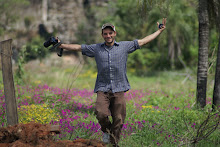
Climbing from the Heart


Paraguay is not known for anything. Land locked in the heart of South America; it is a country of six million, the size of California, swallowed up geographically by its neighbors, Bolivia, Brazil and Argentina. Outdoor enthusiasts would not be looked at cross wise for moving from the beaches of Rio de Janeiro to the high peaks of the Andes and on down to the wind sweep plains of Patagonia without giving Paraguay a second thought. Globe trotting climbers would give even less of their fanatically driven attention for big walls and vertical spires to lowly Paraguay.

No longer.

Over the past year, three individuals have been quietly cultivating their climbing passion in a country as far off the map and as virgin as any modern day explorer could dream.

In the established world of climbing where first ascents and new routes are discussed and determined by degree, Climbing in Paraguay by contrast is wide open. Climbing in the town of Tobati, seventy kilometers northeast of Paraguay’s capital Asuncion, former Peace Corps Volunteers Jonathan Bibee and Dale Helm, along with close Argentine friend Hugo Vidomlansky recently bolted the first handful of sport routes in the country. With kilometers of unexplored wall and the sun shining hot and bright, there is much to be done.

Although Paraguay is not fated to become a premier climbing destination, nevertheless there is a certain sense of pride and a sparkle of contentment knowing that first ascents are not reserved only for the most elite of climbers on location in some exotic locale.

Beyond the convoluted jargon and often times contrived international climbing culture Paraguay Climbing offers a newness, a freshness, a rawness that harkens back to the days of yore when people went barefoot up the rock face and possibilities were endless.

Taking full advantage of the collective experience and improvements gained over the past fifty years in terms of climbing gear (bought in Argentina or Brazil or hand carried down from the USA), climbing techniques and code of ethics, Bibee, Helm and Hugo Vidomlansky, have discovered a climbing area where it can be applied completely from the ground up.

Constructively and consciously developing unknown walls and a brand new sport that infuses courage, self confidence, communication, fun and awareness to the Paraguayan populace, Bibee and Helm relish the challenge of doing what they love, loving what they do and making it accessible to any and all Paraguayans willing to step into a harness and confidently call out the climbing commands “On Belay…. Climbing.”

Thursday, December 3, 2009

EL ESTADIO DE SAN VICENTE


Over the last two years the wheels of life have certainly rolled on in every fathomable direction. But the beauty of a circle is that, no matter how large the circumference, as one travels its trajectory, one must eventually return to the place of embarkation.

In 2007 as I rode across the Indian subcontinent, Team America (you) graciously raised money to help complete the construction of a community soccer field in my former Peace Corps Site of San Vicente. 15 dollars for 1500 kilometers ridden. Team Paraguay (the family members of San Vicente), chipped in with 15 thousand guaranies (three dollars) for 1500 kilometers ridden.

The grand total of money raised was close to a thousand dollars.
The funds were used to level the pitch, add grass and build bleachers.

In 2009, last week, I had the opportunity to return to San Vicente after a two-year absence. Arriving on a Sunday afternoon, I was certain of two things: it would be a hot, sweaty, uphill seven kilometer walk from the bus stop on the paved highway to San Vicente but it would be worth it for without question every one would be at the San Vicente Soccer Field watching the Partido Hape.

Hape in Guarani means “event” or “the place where something happens.” Partido is Spanish for “game.”

Working in the sugar cane fields all week, come Sunday afternoon, the entire community congregates at the place where the game will be held: the Partido Hape at what is now called El Estadio de San Vicente.

As I walked up the cut dirt road across sprawling fields of electric sugar cane that carried the whispers of the southern wind upon their stalks and through vertiginous dark green woodlands reaching toward the hot subtropical sun hung high against an expansive blue sky the beauty of my visit was visible on my face: a smile of surprise. No one knew that I was returning to San Vicente.

Every Sunday, there are two games played. Eleven v. Eleven. Complete with uniforms and shared soccer cleats. My plan was to catch the second half of the second game.

Even before I crested the last hill and beheld the San Vicente Soccer Field for the first time in its crowded and completed state, the kids playing under the bleachers saw me at a distance, blew my cover and announced my arrival.

Heads turned, hands were shaken and hugs given, questions asked in an incredulous tone, the baby pig soon to be raffled off escaped its caretaker and ran out onto the field.
Play continued without a moment’s pause.

I grabbed a seat on the bleachers with my host family, la Familia Martinez, took in the soccer scene and began to catch up on all the local news. Within a heartbeat I was back sitting in the midst of the San Vicente Community and to them that is what mattered most. Not where I had been or what I was doing for the past two years but that I was back and that I had remembered.

Thanks to your support for a bike ride in a far off land more than two years ago, a soccer field was build and a community grown closer. Well Done.

The day’s game ended in a 2-2 tie, which meant penalties kicks would decide the winner.
As the players concentrated and the fans braced themselves in anticipation, there was one more trick to pull out of my sleeve.

Prior to leaving for Paraguay in August, a dear friend of mine gave me three high quality soccer balls to bring down to give to San Vicente. Perhaps I have watched too many international soccer tournaments, but the timing was just too perfect. I jumped off the bleachers, grabbed the deflated balls out of my bag, ran over to the referee and in a hasty presentation explained that “if we are going to play good soccer, on a good soccer field, we need to have good soccer balls.”

The balls were quickly inflated, flexed and kicked around in admiration and appreciation and put directly into play. Thank You Todd.

If you are keeping score, your scorecards should read as follows:
Zorrilla Kue 5 – Nacional 4 in a penalty shoot out.
One Giant Thank you from Team Paraguay to Team America.