Saturday, December 12, 2009

Climbing from the Heart


Paraguay is not known for anything. Land locked in the heart of South America; it is a country of six million, the size of California, swallowed up geographically by its neighbors, Bolivia, Brazil and Argentina. Outdoor enthusiasts would not be looked at cross wise for moving from the beaches of Rio de Janeiro to the high peaks of the Andes and on down to the wind sweep plains of Patagonia without giving Paraguay a second thought. Globe trotting climbers would give even less of their fanatically driven attention for big walls and vertical spires to lowly Paraguay.

No longer.

Over the past year, three individuals have been quietly cultivating their climbing passion in a country as far off the map and as virgin as any modern day explorer could dream.

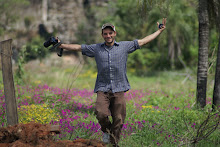
In the established world of climbing where first ascents and new routes are discussed and determined by degree, Climbing in Paraguay by contrast is wide open. Climbing in the town of Tobati, seventy kilometers northeast of Paraguay’s capital Asuncion, former Peace Corps Volunteers Jonathan Bibee and Dale Helm, along with close Argentine friend Hugo Vidomlansky recently bolted the first handful of sport routes in the country. With kilometers of unexplored wall and the sun shining hot and bright, there is much to be done.

Although Paraguay is not fated to become a premier climbing destination, nevertheless there is a certain sense of pride and a sparkle of contentment knowing that first ascents are not reserved only for the most elite of climbers on location in some exotic locale.

Beyond the convoluted jargon and often times contrived international climbing culture Paraguay Climbing offers a newness, a freshness, a rawness that harkens back to the days of yore when people went barefoot up the rock face and possibilities were endless.

Taking full advantage of the collective experience and improvements gained over the past fifty years in terms of climbing gear (bought in Argentina or Brazil or hand carried down from the USA), climbing techniques and code of ethics, Bibee, Helm and Hugo Vidomlansky, have discovered a climbing area where it can be applied completely from the ground up.

Constructively and consciously developing unknown walls and a brand new sport that infuses courage, self confidence, communication, fun and awareness to the Paraguayan populace, Bibee and Helm relish the challenge of doing what they love, loving what they do and making it accessible to any and all Paraguayans willing to step into a harness and confidently call out the climbing commands “On Belay…. Climbing.”

Thursday, December 3, 2009

EL ESTADIO DE SAN VICENTE


Over the last two years the wheels of life have certainly rolled on in every fathomable direction. But the beauty of a circle is that, no matter how large the circumference, as one travels its trajectory, one must eventually return to the place of embarkation.

In 2007 as I rode across the Indian subcontinent, Team America (you) graciously raised money to help complete the construction of a community soccer field in my former Peace Corps Site of San Vicente. 15 dollars for 1500 kilometers ridden. Team Paraguay (the family members of San Vicente), chipped in with 15 thousand guaranies (three dollars) for 1500 kilometers ridden.

The grand total of money raised was close to a thousand dollars.
The funds were used to level the pitch, add grass and build bleachers.

In 2009, last week, I had the opportunity to return to San Vicente after a two-year absence. Arriving on a Sunday afternoon, I was certain of two things: it would be a hot, sweaty, uphill seven kilometer walk from the bus stop on the paved highway to San Vicente but it would be worth it for without question every one would be at the San Vicente Soccer Field watching the Partido Hape.

Hape in Guarani means “event” or “the place where something happens.” Partido is Spanish for “game.”

Working in the sugar cane fields all week, come Sunday afternoon, the entire community congregates at the place where the game will be held: the Partido Hape at what is now called El Estadio de San Vicente.

As I walked up the cut dirt road across sprawling fields of electric sugar cane that carried the whispers of the southern wind upon their stalks and through vertiginous dark green woodlands reaching toward the hot subtropical sun hung high against an expansive blue sky the beauty of my visit was visible on my face: a smile of surprise. No one knew that I was returning to San Vicente.

Every Sunday, there are two games played. Eleven v. Eleven. Complete with uniforms and shared soccer cleats. My plan was to catch the second half of the second game.

Even before I crested the last hill and beheld the San Vicente Soccer Field for the first time in its crowded and completed state, the kids playing under the bleachers saw me at a distance, blew my cover and announced my arrival.

Heads turned, hands were shaken and hugs given, questions asked in an incredulous tone, the baby pig soon to be raffled off escaped its caretaker and ran out onto the field.
Play continued without a moment’s pause.

I grabbed a seat on the bleachers with my host family, la Familia Martinez, took in the soccer scene and began to catch up on all the local news. Within a heartbeat I was back sitting in the midst of the San Vicente Community and to them that is what mattered most. Not where I had been or what I was doing for the past two years but that I was back and that I had remembered.

Thanks to your support for a bike ride in a far off land more than two years ago, a soccer field was build and a community grown closer. Well Done.

The day’s game ended in a 2-2 tie, which meant penalties kicks would decide the winner.
As the players concentrated and the fans braced themselves in anticipation, there was one more trick to pull out of my sleeve.

Prior to leaving for Paraguay in August, a dear friend of mine gave me three high quality soccer balls to bring down to give to San Vicente. Perhaps I have watched too many international soccer tournaments, but the timing was just too perfect. I jumped off the bleachers, grabbed the deflated balls out of my bag, ran over to the referee and in a hasty presentation explained that “if we are going to play good soccer, on a good soccer field, we need to have good soccer balls.”

The balls were quickly inflated, flexed and kicked around in admiration and appreciation and put directly into play. Thank You Todd.

If you are keeping score, your scorecards should read as follows:
Zorrilla Kue 5 – Nacional 4 in a penalty shoot out.
One Giant Thank you from Team Paraguay to Team America.

Saturday, November 14, 2009

Paraguayan Logic: Some Good, Some Bad, Some Funny, Some Tragic


FOR WANT OF AN EXTENSION CORD

Between 1975-1991 the Itaipu Dam was constructed on the Parana River between Paraguay and Brazil. Costing upwards to 20 billion dollars, upon completion it was the world’s largest dam, producing nearly 14 Gw of energy per year. (Currently, the Three Gorges Dam in China has taken over as the world’s largest). In percentage terms, the dam supplies 90% of all energy consumed in Paraguay and roughly a fifth of that used in Brazil.

However, almost twenty years on and there are still communities in rural Paraguay that do not have running water or electricity.

THE MISSING INGREDIENT IN THE TABLE SALT

A goiter is a swelling of the neck resulting from the enlargement of the thyroid gland. It is caused by a deficiency in iodine. This iodine deficiency in the diet of the world’s population, and thus the growth of goiters has been effectively curtailed through the addition of iodine into common table salt. This ingenious, effective and economic solution was devised almost a century ago.

Recently however, while I was out visiting a subsistence farming family the wife of the couple with whom I was staying had a goiter. She is 70 and unfortunately grew up in a place and time where there was no iodine in the salt. The time and place in question is Paraguay in the 1950s.

Note mind you that this tragedy of health is not due to lack of iodine availability but rather the more pernicious fact that the Minister in charge of making sure that there was sufficient iodine in the table salt under the Paraguayan Dictator Alfredo Stroessner (1954-1989) was instead pocketing the money and falsifying his reports.

EXPORT –IMPORT

A woman out in the rural Paraguay has fourteen children. Three have died and the rest are all grown. Two are farmers and live in the same community in which they grew up.
The rest, nine, are all abroad in search of work. Seven have gone to Buenos Aries while two have ventured as far afield as Spain. One of Paraguay’s biggest exports is people. All gone, without education or a skill set to speak of but faced with a life to live. The woman speaks longingly of her faraway children and their hardships as she tends to the evening meal over an open ground fire in a soot covered wooden kitchen. Kids grow up and get gone; gainful employment is an elusive mirage both home and abroad and remittance is hard pressed to trickle home.

HAKU

Hot, at best, is only truly a rough approximation of the Guarani word “Haku.” Sitting directly on the Tropic of Capricorn, Paraguay pushes the heat index to new levels.
Haku can best be described as follows: sitting on the beach toasting your body, perhaps reading a book or sipping on a cool beverage, you suddenly become aware that the sun’s rays and heat has reached an almost unbearable, intolerable level. You quickly jump up, rip off your clothes and run into the refreshing ocean water… Ahhhhh.
Well, since Paraguay is a land locked country, there is no water. Everybody instead sits at that unbearable, intolerable level of hot sipping beverages where the ice melted away long ago. Haku….

For a little more insult to injury:
Back to our man, Dictator Stroessner. During his rule, 1954-1989, by official order he never allowed the temperature posted in the upper right corner of every one’s television screen during the nightly newscast to go above 29 degrees Celsius. No sweat, just a mere 84 degrees Fahrenheit down here in this tropical Paradise called Paraguay.

HELLO – GOODBYE

Paraguayans are certainly not known for being in a hurry. The “haku” heat has seen to a decidedly slower pass of life.

But Paraguayans must be given credit for their efficiency, succinctness and bluntness. When walking past any one on the street, whether be it in the city or the country, rather than give the hollow, noncommittal “Hello, how are you,” they will cut to the chase and say “Adios.” That is right, goodbye. As you walk past some one you have never seen before and have no intention of stopping to talk to, you say Goodbye. While not breaking your stride you both are politely on your way.

Adios…

Saturday, November 7, 2009

To Rake and To Fertilize


To Rake and To Fertilize
To Slash and To Burn

A man goes into the forest and cuts a tree down, a few trees, many trees.That same man returns three months later and burns everything in sight.

By all accounts this should be appalling and that man thrown in jail for environmental destruction, arson, etc.

On the other side of the world, a man goes out into his backyard, rakes up all the fallen leaves, every last one of them, and puts them to the curb never to be seen again.
That same man, three months later returns to his backyard after a harsh winter and applies chemical fertilizer to his green grass lawn.

By all accounts this should seem normal and that man praised for being an upstanding suburban home owner taking pride in his property.

Man Number One has just practiced traditional Slash and Burn Agriculture. He represents one of the billions of subsistence farmers that literally make their living off the land of this great Earth. The wood he has cut down has built his house and cooked his food. The land he has burned has grown the crops that have provided for his family.

The ironic thing about Slash and Burn Agriculture is that it works. When a farmer burns a parcel of land, rather than destroying the soils productivity, it actually boosts it. The fire unlocks precious nutrients, nitrogen, potassium, phosphorus, that are present in the soil but structured in such a way that they are unavailable for plants to use. In addition, the newly created ash reduces the soil acidity (a common characteristic of tropic soils) by raising the pH and thus provides a more fertile environment for plant growth.

Man Number Two has just practiced traditional Suburban Middle Class Lawn Care. The leaves that are on the ground, although they are the primary source of organic material that if left will replenish the nutrient deficiencies of the backyard lawn, are seen as messy, unkempt and thus must be swept away. It’s a good feeling: to keep everything clean and tidy and the neighborhood pristine and orderly.

It has been proven that people fear death and public speaking. At times, most of us fear public speaking more than death. It could also be ventured that no one wants to be the only guy on the block with the brown and dying lawn. So out we go, motoring off to the local hardware store or garden center to buy the organic material we shipped off the autumn prior and color correct our lawn from a waning yellow to a verdant green through a healthy dose of chemical fertilizer.

The funny thing about traditional Suburban Middle Class Lawn Care is that it is purely cosmetic. Leaves get raked; grass gets cut, watered and fertilized because it makes the lawn, our lawn, look good. No one, neither cows nor humans, have to eat off this suburban landscape. Bare feet and blankets, barbeques and bocce ball are the beneficiaries of our lawn care diligence.

The catch with Slash and Burn Agriculture is that it does not work in the long run. With population growth and limited land availability, Land has been forced into continued cultivation and not given the necessary time to lie fallow and recuperate. Subsistence farmers the world over are faced with poorer soils, reduced yields and increased economic hardships.

The catch with traditional Suburban Middle Class Lawn Care is that it works all too well in the long run; just buy better genetically engineered grass seed, higher concentrations of fertilizer, more ergonomic rake handles to take the strain off the lower back and more powerful leaf blowers.

If a subsistence farmer must begin to change his agricultural attitudes and practices to sustain his very livelihood and contribute to the idea and reality of a greener planet, correspondingly Suburban Middle Class Lawn Owners must awaken to the notion that we in fact must do the same.

Friday, October 16, 2009

PAVE PARADISE AND PUT UP A …..HIGHWAY…PLEASE


If need be, everyone can walk 15 kilometers. It might take some of us all day, but the distance, roughly nine miles, is certainly traversable. For the developed world, a 15 km walk can be called an outing, a day hike, a backpacking trip. People plan weekends to do it; Boy Scouts can earn merit badges for it. In sum, walking 15 km is a luxury not a necessity. To cross that distance is what a private motorized vehicle is for.

In the developing world however, for subsistence rural farmers, a 15 km walk is a fact of life. Out in the countryside, pavement is a limited quantity and the sidewalk ends rather quickly or far from home depending on which way you are looking.

Walking is at once a part of the traditional, agrarian routine and yet a constant and obstinate geographic impediment to connection to the greater wide world.

Fifteen is only the average, used here metaphorically, it could be only 5 or 10 km, or as much as 20, 25 km and beyond. We are talking about fifteen kilometers of dirt, mud, earth roads between a community where someone lives and the nearest paved road, where the rest of the world lives.

As the crow flies the distances are short but the consequences are long and profound. The lack of all weather paved roads takes measurable distances and makes them really quite immeasurable in terms of time, economics, psychology, culture, receptiveness to new ideas and ultimately livelihoods.

Fifteen kilometers on asphalt takes a half and hour to drive. Fuel costs are negligible and produce will certainly not rot en route. The same distance on dirt roads can take an hour, an afternoon, a day. It really is any one’s guess, depending on the weather, road conditions and how big those erosion ditches have become since the last rain.

If there is a doubt whether a farmer can get out to sell or some one can get in to buy and transportation costs will consume most of his earnings, it’s a certainty that a farmers choices on which cash crop to plant will be severely restricted. Fifteen kilometers can be the distance and difference between subsistence and upward mobility.

We love to love nature. However, the catch is that we love to love it as long as it’s easily accessible through a reliable network of roads. Most of us enjoy the thought of spending the day out in the wilderness but with the benefit of being able to get away from it and return home at the end of the day.

We are quick to criticize large-scale public works projects that tend to pave the world over. However, we do prefer individual pavement projects that come right up to our garage door.

The next time you gaze upon that ubiquitous black expanse called asphalt, learn to step a little more lively and tread a bit more lightly, for it has taken us far. Let’s hope it starts taking the rest of the world, mired in mud and poverty in the same direction.

Tuesday, September 15, 2009

LIFE IN PERSPECTIVE

The animosity between Paraguayans and Argentines is good natured but visceral. From boasts and brags of cultural superiority to a devastating 19th century war, the Triple Alliance War 1861- 1865, that literally decimated the Paraguayan population (Argentina was helped out by Brazil and Uruguay but in their defense, Paraguay did start it, declaring war on all three), this rivalry finds its outlet in all forms of life.

Being South America, a soccer match played between the two national teams serves as unparalleled battle ground for this never ending war. Wednesday night in downtown Asuncion, the Paraguayan capital, in the form of a 2010 World Cup Qualifying Match, the latest Paraguay – Argentina skirmish was fought.

In an unprecedented turn of events, Argentina, a perennial soccer powerhouse and historically a shoe in for a World Cup berth, came to town needing a win to keep their flagging campaign alive. Paraguay, on the other hand, was in the position where a win would seal their invitation to the big dance in South Africa in June of next year. (After two years of home and away tournament play, only four out of the ten South American teams will earn berths to the World Cup). Although unknown on the world stage for anything else, in soccer circles, the small, six million strong land lock nation of Paraguay is a force to be reckoned with.

Qualifying for the World Cup at home and at the expense of their arch rivals, Argentina, were another loss would virtually eliminate them from World Cup contention was almost too much for Paraguayans to handle.

At kick off, the energy in the stadium was electrifying and the silence throughout the country was absolute. The nation had stopped, all motion suspended, everyone glued to their televisions and collectively holding their breath. Across the border in Argentina, there was no less concentration and devotion.

In this corner of the world, on that night, there was only one thing and one thing only that mattered: the best eleven men of each country playing ninety minutes of soccer to decisively determine the power, glory and right to go to the World Cup.

Despite the best of intentions and a commensurate amount of hard work, Paraguay,
in terms of soccer, history and politics, is benighted and hapless. The national team, for as talented as they are, always finds away to let victory slip through their fingers, like a late opponent’s goal sneaking past the goalie’s outstretched hands.

The Paraguayan populace knows this all to well and, during the run up to the game, they were on their knees praying for a different outcome to the same old story.

On a night that will be talked about and lionized for generations, the national side did not disappoint. Playing as a team, aggressive and hungry for a win, Paraguay beat the Argentines 1-0. Paraguay hit the post twice before they found the back of the net. Tensions and jockeying for the ball were unrelenting throughout, ending in a red card for an Argentine player. Despite being a man and a goal down, the ultimate opportunity for vindication if not outright victory was Argentina’s. But the striker missed tapping in the superbly placed cross in front of an open net by centimeters in the final minute of the match.

As the ball spun out of bounds and into oblivion, the nation of Paraguay leapt up in euphoria as the national team stepped into history.

In a single, 1-0 victory over Argentina, the plight of Paraguayans was forgotten. No one left the stadium or turned off their televisions. This was not just soccer. It was life, renewed, reborn and rejuvenated.

As the players danced, the fans cheered and flags waved, the President of Paraguay, Fernando Lugo, stepped onto the pitch. With six million people enthralled to a Paraguayan victory, he did the only logical thing: he declared Thursday, the following day, a National Holiday.

Schools were closed. Government offices shut down and stores remained unopened.

The mundane transactions of life could wait another day. An Argentine loss, a Paraguayan World Cup berth. This was big. Down right momentous and needed to be put into proper perspective.

CPI: CHIPA PRICE INDEX

Putting a finger on the peculiarities of the Paraguayan pulse is always a tricky affair. The pervasiveness of Paraguayan indirectness can stymie the simplest of questions. Are you going to the party tomorrow can be met with a myriad of responses.

One could make the case that cultural indirectness is indeed so profound that it is imbedded in the grammatical structure of the language. In Guarani all questions are asked in the negative form. Ndeho moa’i la fiestahape? You are not going to the party? How is one to answer this inquiry directly?

Against this cultural backdrop and the reality of widespread poverty in Paraguay, figuring out the financial and economic climate of rural Paraguayans is a daunting and delicate task indeed.

There is a way however to go about it without getting too personal, too professional and distracted by facts and figures. Beyond the traditional consumer price indexed basket of goods, such as flour, salt, oil and the like, to serve as a bench mark for measuring year on year inflation Paraguay offers a single consumer product that can get at the heart, or really the stomach, of the economic matter: chipa.

For the uninitiated, chipa, can be thought of as a corn meal Paraguayan bagel. The freshly ground corn is mixed with copious amounts of milk and lard, sprinkled with a healthy dash of anis seed, brick oven baked and served piping hot along the major paved thorough fares of Paraguay (now numbering twelve in a country the size of California) by industrious women touting massive baskets perched atop their perfectly erect heads.

For Paraguayans buying chipa is not really an option, but more a requirement born out of tradition, habit and hunger for a delicious snack. Without exception long distance buses traveling to and from the capital, stop and pick up a prearranged chipa woman, specifically at km 74 on Route Two, to sell their corn meal morsels to hungry passengers. Different bus lines work with different chipa companies, where the bus driver undoubtedly gets a free sample.

Back in 2002, a single chipa, the size of a good New York City bagel (Sara Lee supermarket bought, five to a sleeve “bagel” look a likes need not apply), sold for 1000 guaranies, the Paraguayan currency which floats freely against the dollar and is presently valued at 1 USD = 4900 guaranies. Thus, a chipa cost roughly twenty cents. To complete the comparison, a typical Paraguayan day laborer makes 25,000 guaranies or five dollars a day.

Over the last half dozen years however, while the price of chipa has remained stable at 1000 guaranies , the size has steadily decreased to that of a Thomas English Muffin. Unscientifically, this reflects two trends: the rise in the cost of raw materials (i.e. corn, lard) and the idea that 1000 guaranies is the Paraguayan psychological price akin to 99 cents.

Returning to Paraguay after a two year absence, I was eager (and hunger) to continue my chipa price index study on the rural economic situation of Paraguayans.

Traveling out to the eastern department of Caazapa, I made my requisite stop along Route Two to purchase my tasty, Paraguayan roadside snack. Driving in a private vehicle, I rolled down the window and opened my wallet, not knowing what to expect.

The woman, basket atop her head, leaned in and handed me a chipa. The size was back close to its original (2002 baseline) but the price was now double: 2000 guaranies. Being caught short, I had to reach deep into my pocket to make up the difference.

The sweetness of the snack was the same as I had remembered, but I got the feeling that over the intervening years this slice of rural Paraguayan life had become a bit more sour and hard to swallow.

Chipa in hand, Paraguayans can attest to the following as they scratch out a subsistence living in an acute economic environment: the problem with “normal” is that over time everything gets worse.