Saturday, February 2, 2013

Tropical Three Step


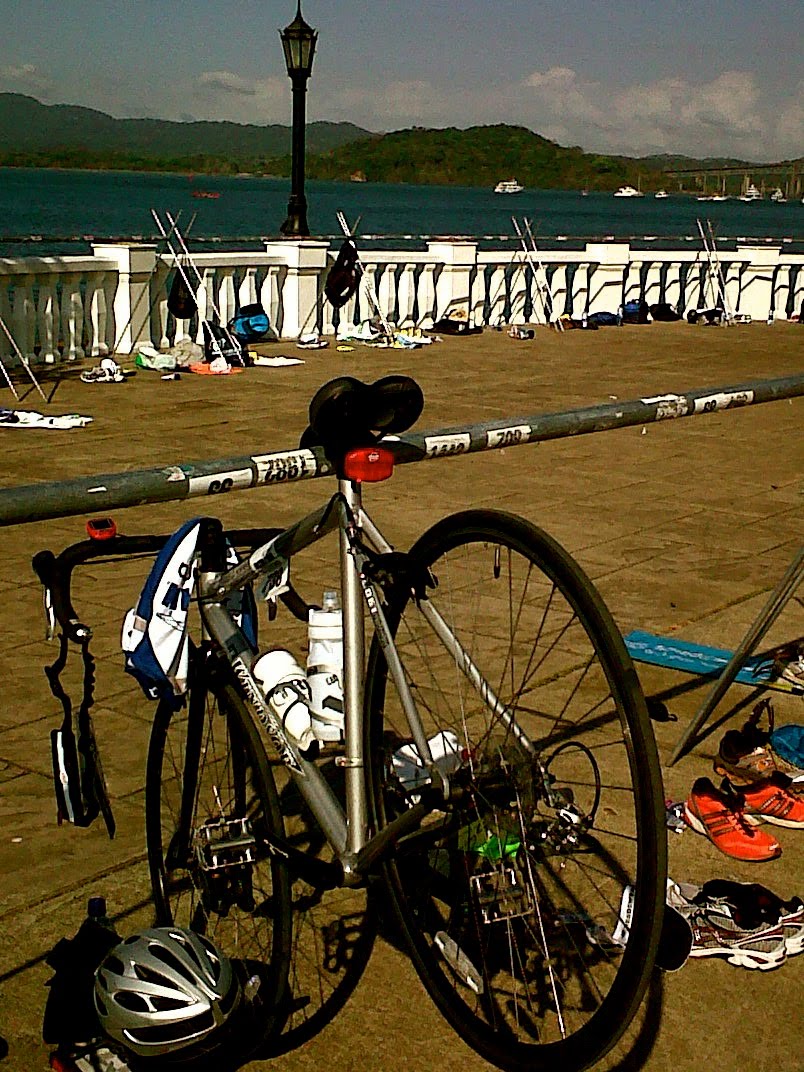
The journey of a thousand miles begins with..... 70.3

1.2 Mile SWIM. 56 Mile BIKE. 13.1 Mile RUN.

Under the hot tropical sun

Pumping the Positivity.

Thursday, November 15, 2012

"Hippo - Hurricane - Howler"

Snapshots from Sandy 

'Darkness on the Edge of Town'

'Proceed with Caution'
'Stabbed in the Back'

Monday, October 15, 2012

Pint Sized Perplexity - A Photo Essay


Despite its diminutive size –600 miles long by 100 miles wide— Panama packs a punch. Tropical beaches, mountain terrain, and dense jungle; the country ties it all together with a twist of culture and logic all its own.

'Light Up Your Christmas Tree'
Asserting One's Independence 
During the month of November, Panama celebrates two independence days: one from Spain and the other from Colombia.


'Southbound ?'
End of the Road – Yaviza, Darien, Panama
The infamous Darien Gap. The mighty Pan American Highway, stretching form Alaska all the way to the southern tip of Chile suffers a single break in its otherwise unbroken ribbon of black asphalt. Without warning, the highway abruptly ends in the eastern town of Yaviza – terminating at the Chucunaque River and leaving only jungle beyond. Roads do not resume until deep into Colombian territory. 

'More Miles to the Gallon'
License and Registration  
Putting it lightly, traffic laws are lax on the isthmus. Bicycle owners however are required to obtain a license plate to operate their pedal powered pushcarts in Panama.

'Something About an Albatross'
A Drop in the Bucket
In a single month this year, 39 inches of rain fell in the Caribbean Province of Bocas del Toro.
Panama is practically surrounded by water and yet, more than 50% of all Panamanians – close to 90% of all indigenous communities – lack access to clean, reliable drinking water.

Going, Going, Gone.....
Deep, Deep Right Field. 
While Yankee Stadium with its 'short porch' in right field can be considered a home run hitter's dream, the Bocas Town community baseball field could qualify for an air traffic controller's nightmare. Right field extends to become an international landing strip.


Sunday, August 26, 2012

PANAMA

COMARCA NGABE BUGLE

Tuesday, June 12, 2012

Continental Synapse

The crenellated castle walls stood crumbing for centuries. The staccato slap of bare feet against stone and the occasional whack of a soccer ball against the once formidable meter thick walls are the only echo of a by gone era of ramparts and rockets.

Jutting out to sea at the very northwest edge of the African continent, the old city— al medina— of Tangier keeps a watchful gaze on the Atlantic Ocean, Mediterranean Sea and its rocky reflection, the Rock of Gibraltar, a mere ten miles to the north.

The byzantine streets, predating the adjective itself, wind deep into the city center without a thought of an escape. Vendor’s stalls, motorbikes, and pedestrians vie for the precious free space offered in the back alleyways. The city swirls with the scents, spices and sophistication of two colliding continents. The population erupts in a cacophony of Arabic, Berber, French and Spanish. As a crossroads of civilizations, commerce and culture compete to be the champion of conversation.

Mint tea, hot and copious, serves as the elixir of life; keeping those who imbibe upright and active. The call to prayer cuts the commotion to silence with a single Allahu Akbar, reminding the faithful of the celestial traverse of the sun and the presence of a higher authority.

Tuesday, May 15, 2012

CLIMB ON


The 18 volt pneumatic hammer action drill grinds to a halt.

The rock is too hard for the power tools on hand. The midday tropical sun mercilessly bakes my body, making putty out of my black rubber soled climbing shoes. I hang, tired and scorched, as if on a vertical granite frying pan. My belay partner below is no more fortunate. Suffering the same sun, he holds me in place, waiting for word of what will come next.

Whether it is the bit, the battery or a problem with the motor itself, the outcome is the same: the drill is silent (just another 10 kilos of metal strapped to my harness) much like the rock face has been for millennia.

We are half way through setting the third bolt of a seven bolt route. The first route ever attempted on this mountain – Cerro Mbatovi. Loosely translated from the indigenous Guarani as ‘Balcony of the Gods’ or ‘Window to Heaven,’ Cerro Mbatovi is a solitary rock massif rising abruptly out of the central Paraguayan plains in the Department of Paraguarí. Its rock head caps an apron of subtropical forest. The summit approach requires an arduous bushwhack through jungle underbrush and a hard rock scramble above tree line. Untouched and unclimbed, Cerro Mbatovi offers a rock climber's dream: a wall of first ascents.

Not to be bested, out comes the Petzl Rock Pic and mini sledgehammer. Setting the pic in the half finished hole, the operation is straightforward if brutal: A whack of the hammer followed by a quarter turn of the pic. Hammer drives pic; pic chisels rock. Repeat for forty-five minutes. This bolt will be secured by hand.

Welcome back to rock climbing in Paraguay. A mix of modern technology and old-fashioned rock climbing determination set in the heart of the South American continent.

Two years ago Rock and Ice Magazine (see article http://rockandice.com/news/500-Paraguay-An-Emerging-Scene) relayed the activity of Paraguay’s nascent rock climbing scene to the world. In the interim, climbers Jonathan Bibee and Dale Helm, aided by Mexican climber Victor de Leon and a growing cadre of home-grown talent, have made steady progress.

Successfully bolting two dozen routes in the Cerro Cora climbing area, 60 km to the northwest, in the town of Tobati. The pair has set their sights on Cerro Mbatovi. To say Bibee and Helm have discovered these climbing locales would be unjust. The Paraguayans have known of these rocks for centuries. The two climbers just see them with a new set of eyes: offering the country a new sport and the worldwide climbing community a new climbing destination.

“Ita Jupi”— rock climbing in Guarani— is wide open for exploration, development, conservation, and celebration. Cerro Mbatovi's climbing future remains to be written.

Tuesday, April 10, 2012

Sunday, February 12, 2012

Canal Correspondence


The Panama Canal has cut through the Central American isthmus and connected the Caribbean and Pacific Ocean for a century. This morning a small cadre of dedicated athletes swam through it, biked over it and ran along side it.

In hosting its first ever ‘half ironman’ -a 1.2 mile swim, 59 mile bike, and 13.1 mile run— the City of Panama turned over this iconic venue –a sea level canal framed by the juxtaposition of jungle covered hills and gleaming skyscrapers— to top flight triathletes and endurance amateurs alike.

As cargo ships steamed north toward the Miraflores Locks, swimmers’ arms rose and fell with disciplined cadence in the canal’s current as they entered the Pacific. Transforming themselves into cyclists, the triathletes rode over the Bridge of the Americas –the first bridge to span the canal– for a thirty-mile there and back. Trading wheels once more for pure human locomotion, the triathletes ran the remainder of the race on a ribbon thin causeway constructed from the canal’s excavation.

One Lance Armstrong –seven time winner of the Tour de France and cancer survivor- graced the race with his presence; immediately granting the inaugural competition with prestige and worldwide recognition. With the carriage of a Greek god, Armstrong held the lead until the final moments when a New Zealand competitor bested him.

Panama, home to three million inhabitants stuck to a jungle green landmass shaped like a stick of gum, is stretched by contradiction and cultural complexity. Boasting a $5.25 billion dollar canal amplification project for a waterway that generates millions of dollars in weekly revenue and a highly developed financial sector, Panama still harbors a subsistence farming, lack of potable water poverty rate of ~15%. In addition, expanding American Baby Boomers’ beachfront enclaves now but up against autonomous indigenous regions of the Ngabe Bugle, Kuna Yala, Wounaan and Embera who have managed to maintain their distinctive, centuries old cultural traditions.

Much like the efforts of any triathlete. Investment in expensive, technologically advanced equipment (feather weight shoes, carbon fiber bikes, enlarged canal locks) can only take Panama’s social and economic development so far. It is only the huge human component which makes success achievable: the hours of countless physical training, the extraordinary effort needed to execute community level capacity building programs.

The original fitness guru Jake Lalane is famous for saying: “Train for life as if it were an Olympic event.” Today’s triathletes epitomized this statement. Panama's development efforts should take note. Hosting its first half ironman is a good start, but completing the competition and improving the quality of life of its citizens is a whole different challenge.

Monday, December 5, 2011

In Pursuit of Peace: Mark it on your Calendar

The following photos were selected to grace the cover and the month of March in the 2012 Returned Peace Corps Volunteers International Calendar.

Please click here to view the entire calendar.


PANAMA

The beans, handpicked and slow roasted, are taken from the fire and set in a large wooden bowl to cool. The inescapable aroma of coffee permeates the highlands of tropical Panama. Served strong, dark and sweet, coffee is more than a hot beverage to get the morning started. Offered to all visitors, it is a mark of hospitality, an invitation for intimacy, and the Jimenez family brews an impeccable cup. Here Kayme picks through the cooling beans, adding anise leaves, snatching up the best ones to pop in her mouth. Soon, the beans will be ground, pressed, and shared by all.


MOLDOVA

The afternoon silence is torn by the rolling thunder of wheel on rail as the train trundles into the station in Chisinau, Moldova, the capital of Europe’s poorest country. The locomotive chokes to a stop, towering over the central platform. Patient, a woman waits as the hiss of the diesel engine fades to silence and stillness reclaims the afternoon. Deliberate, she stands and walks purposefully to the train’s door. Slow. Steady. She grabs the handrail, steps up, and boards the train. All are aboard, waiting to depart.

Sunday, November 13, 2011

Cerro Mbatovi: Balcony of the Gods


Loosely translated from Guarani as "The Balcony of the Gods," Cerro Mbatovi rises abruptly out of the grasslands of the Department of Paraguari. A solitary rock massif, Cerro Mbatovi represents the newest locale of a nascent rock climbing scene in Paraguay.

The summit approach requires an arduous bushwack through jungle underbrush and a hard rock scramble above tree line. Untouched and unclimbed, Cerro Mbatovi offers a rock climber's dream: a wall of first ascents. Currently being explored via top ropes and "bee veil rappels" (for red jungle wasp control) to develop potential rock climbing routes, Cerro Mbatovi's climbing future remains to be written.

Here is a link to the first article about rock climbing in Paraguay published on Rock and Ice, an international rock climbing magazine.

Saturday, November 12, 2011

Paraguayan Primavera


To the northern hemisphere's autumnal transformation, the southlands respond with a brillant flash of primaveral pastel. Here the Tajy Say'ju (the Lapacho Amarillo), a native tree to Paraguay, shines brightly in the church plaza of the pueblo of Guarambare.

Wednesday, February 16, 2011

Ice Climbing: Water + Cold + Gravity + Determination


H—O—H.

There it is. This naturally occurring simple sequence is absolutely fundamental to life’s existence. H20. A single oxygen atom covalently (sharing of electrons) bonded to two hydrogen atoms. By all accounts the bond of this crystalline formation is a weak one. What water lacks in bonding strength however, it makes up for in structural stability.

Drop the ambient temperature to zero degrees centigrade and a molecule of H—O—H actually expands— the only known non-metallic substance to do so upon freezing— to form transparent or opaque bluish-white hexagonal crystals. A solid state which is peculiarly less dense than its liquid counterpart.

This process happens daily in the safe confines of your freezer. The ice cube tray is cracked and emptied. An ice-cold beverage is enjoyed. The tap is turned on. The tray refilled and placed delicately back in the freezer. This great transformation from liquid to solid has been tamed for our own consumptive pleasure.

Water into ice. This process also happens daily in the winter wilderness of the great outdoors. Snow melts, water seeps down rock faces, waterfalls flow over cliffs. There comes a point however when the temperature freezes and all motion stops. Running water solidifies in midair.

Brilliant in their hues of blue and white, these ice formations tower above the forest floor like silent sentinels over the winter landscape. From below the view is breathtaking. From the top it is commanding. Stack enough ice cubes on top of one another and suddenly there is a mountain to climb.

On Sunday February 13th, ten New School students, aided by the professional guiding service High-Xposure, donned crampons and helmets, harnessed in and roped up, grabbed a pair of ice picks and climbed their way up 30 feet of sheer ice.

Water’s hydrogen bonds are weak but ice’s overall structure is strong. Strong enough to drive an ice pick through and hold your body weight as you dig your metal spiked boots in and pull yourself up.

Gravity exerts a constant downward force. Determination, if you choose an ever increasing upward one. The sun gleams off the frozen surface, you grit your teeth and smile….

Think of this the next time you reach for an ice-cold beverage…..
New School Recreation Outdoor Education: Leave The Library. Escape The City. Learn For A Lifetime. What Does Your Facebook Status Say…..?
SKI TRIP FEB 25-27. WHITEWATER RAFTING APRIL 16-17. ROCK CLIMBING MAY 7.

Thursday, January 20, 2011

A Journey Of A Thousand Miles Begins With A Single Step.


This statement is as practical as it is profound.

Upon graduation from Georgetown University nearly a decade ago, I embarked on my own journey of a thousand miles. Conscious of the fact that my first steps after college would shape my professional and personal life far into the future; I decided to serve as a Peace Corps Volunteer. Having been afforded every opportunity to learn, to live and to love; I was determined to live my life in the service of others.

Ten years, three Peace Corps Services –Paraguay, Guatemala, Panama— and multiple languages later, service remains the focal point of my life’s journey. My most recent personal step however, has forced me to recalculate where in fact, my journey truly began. It wasn’t the Peace Corps or Georgetown University but rather on 87 Halsey Avenue at Saint Cecilia School.

Returning to Panama in early January to give my Peace Corps Community –El Entradero— a surprise visit after a two and a half year absence, I had a homecoming far greater than expected. Upon arrival in El Entradero –a rural, mountainous community of subsistence farming and intermittent running water and electricity, I encountered a group of American college students from George Washington University and Indiana University there through an organization called Global Brigades to perform a series of community service projects.

While working with the students and community members to build water filtration systems and fuel-efficient brick stoves, I learned that one of the George Washington University students, Francis, was not just from New Jersey but actually grew up in Rockaway and attended St. Cecilia School.

I have had my fair share of chance encounters of geographic kith and kin throughout my travels. Never however, as close as my own catholic grammar school. There amid the coffee plantations on a tropical hillside in Panama, 5000 miles from Rockaway, NJ, Francis and I traded stories of St. Cecilia School. Although nine years separates our time at St. Cecilia, we both had the same seventh grade teacher, Ms. Fitzpatrick, and recalled many of the same experiences.

Although the location of our meeting –in a remote jungle village on the Panamanian Isthmus— is extraordinary, upon deeper reflection, the context of our meeting is far more profound. Francis, as I, could have traveled to Panama, and the greater wide world for that matter, in a multiple of other capacities: tourist, backpacker, on a package cruise disengaged from life around us. Instead, we were there, answering, in our own way, the call to service to others.

A student’s time at St. Cecilia School passes quickly. The education earned at St. Cecilia’s however, lasts a lifetime. Meeting Francis in Panama made me realize that it was here at St. Cecilia School where I took my first step in my journey of a thousand miles.

Wednesday, December 29, 2010

Should I Donate To A Microfinance Institution?


The woman’s eyes sparkle at me from underneath her bowler’s hat. She is caught in mid action, hands deep in a mass of corn meal, kneading the day’s batch of tortillas. Her baby sits propped up on her shoulder— like some newborn quiver of potential oblivious to his immediate surroundings— wrapped tightly to her body by a colorful but worn indigenous shawl.

Of course the woman is just a picture –a greeting card really from some microfinance institution— sitting on the table next to all my other opened but unattended mail. Señora Ana Maria Villalba, the microfinance organization declares, in warm cursive script on the inside of the card, has worked her way out of poverty and started this small but thriving tortilla stall with a microfinance loan made possible by donations like yours.

Pledging ten to twenty dollars will help women like Señora Villalba around the globe break the chains of penury and reach the economic and social empowerment they deserve. Villalba’s smile, broad and genuine, and those eyes, dancing in the early morning light, are cultural ambassadors, a spokeswoman of sorts for the forgotten, unrepresented and, according to the microfinance institution, ‘unbanked.’

Ten …. Twenty bucks? That’s all it will take to help this enterprising woman in some far off land. It’s the price of a movie ticket and some popcorn, a down payment on a Sunday brunch in a trendy café in Brooklyn, an ill advised late night taxi ride to a bar I have no business being at.

What the hell,…twenty buck in NYC is gone in a flash anyway. Spent on some instantly forgotten consumption. At least this is a conscious act. Something I can feel good about. The money will be going to her. Señora Villalba and those like just you, Espera…. I am coming to help.

But hold on just a moment, who is this Señora Ana Maria Villalba, and more to the point, who is this microfinance organization that is purporting to help her? Where is my money really going? I hesitate and palm my twenty dollar bill back into my pocket. I’m torn; should I donate to this microfinance institution or not….. ?


YES. According to Matt Flannery, the Co-founder and CEO of Kiva, an online lending platform which has facilitated over $100 million in microfinance loans since its inception in 2005, making small, private donations to microfinance institutions (MFIs) “allows individuals in the developed world to loan to small business people in the developing world.” The Kiva website explains that “by combining microfinance with the internet, Kiva is creating a global community through lending.” Whether donating online through a ‘microfund’ intermediary such as Kiva or directly to a microfinance institution such as FINCA International, ACCION International or any other smaller microfinance program, the end goal of making small, individual, private donations to MFIs is the same: to empower the working poor by providing access to credit.

In its 2006 “Good Practice Guidelines for Funders of Microfinance” CGAP, the World Bank’s Consultative Group to Assist the Poor, declares that the “microlevel is the backbone of any financial system” and thus the “role of donors and investors is to strengthen financial service providers to achieve financial sustainability –which is essential to reach significant numbers of poor people and to realize long-term social returns— support experimentation, and provide capital to expand the reach of retail financial institutions when the supply of commercial financing is limited.” Indeed, all MFIs pursue multiple avenues of funding, from international official sector grants to loan financing to private donations in order to meet their financial and social empowerment objectives. However, it is the private donations to MFIs that allow lenders to create a human connection with their borrowers and have a direct impact on their lives.

Specifically, private donations to microfinance programs enable MFIs to offer a wide range of financial services —access to credit, savings vehicles, insurance policies– to poor people that were hither to deemed “unbankable” due to their lack of assets and ability to repay their loans. In addition, the capital raised from private donations, plays a vital role in building capacity in both the lending institutions and borrowing clients, where the presence of robust, financially sustainable MFIs can help to facilitate the transition of microfinance services away from informal lending and towards a nation’s formal financial system. Finally, private donations provide an important source of funding for MFIs to cover transaction costs associated with loaning to the working poor. With operating costs covered, MFIs can maintain lower interest rate premiums and thus be able to extend credit to more individuals, particularly women and the extreme poor.

In effect, while a single, private donation can have a positive, direct impact on an individual’s livelihood by providing much needed credit access to start a small business or invest in a child’s education, the aggregate amount of yearly private donations, can help catalyze a much greater cycle of systemic, economic generation throughout the entire community. According to CERISE, a knowledge exchange network for microfinance practitioners, although the relationship between social and financial performance in microfinance has been much debated, their assessment of the ‘Social Performance Indicators’ of 230 MFIs since 2002 confirms that in fact “social performance and financial performance are compatible.” Specifically, although “targeting the poor clearly implies higher costs for MFIs, other aspects of social performance —participatory models, well-adapted loan technologies and social responsibility— are positively correlated with good operational and financial performance.” In effect, microfinance goes beyond the traditional notion of social responsibility –“do no harm”— and has a genuine and attainable mandate to “do good.”

Thus, donating to a microfinance institution has the dual benefit of economically empowering and improving the social well being of the borrowing client. A small, individual donation has the power to attain the important double bottom line of financial sustainability and positive social impact. Kiva concludes that private donations to microfinance programs connect people, create relationships beyond financial transactions and build a “global community expressing support and encouragement of one another.” Ultimately, donating to a MFI is not some faceless onetime act of charity, but rather a “person to person lending” strategy that empowers lender and borrower alike and has a tremendous multiplier effect on the financial, economic and social realities of the lives it touches. In this regard, making a donation to a microfinance institution is the most versatile and impactful way to invigorate the development process and address the devastating effects of poverty.

NO. In “Microfinance Misses Its Mark,” Karnani (2007) warns that “we should not romanticize the poor as entrepreneurs” and thus overstate the effectiveness of microfinance. Karnani contends that “in fact, most microcredit clients are not microentrepreurs by choice but would gladly take a factory job at reasonable wages if it were available.” Put into context, this statement speaks to a broader argument about the limited utility of microfinance vis-à-vis other alternative methods –namely investing in social, education and health services— to lift people out of poverty and ignite sustainable economic growth. Microfinance is not a cure all, and, according to Rosenberg (2010) in “Does Microcredit Really Help Poor People?,” microfinance’s success in expanding the income, consumption and the health, education and social empowerment of its borrowers is mostly anecdotal. There is no clear evidence to show that the hundreds of millions of microfinance clients throughout the developing world actually realize microfinance’s purported goals of economic and social empower. In sum, making a private donation to a microfinance institution (MFI) is neither an effective nor an efficient way to alleviate poverty or to empower people. Private donors and poor borrowers alike would be better served if donations were channeled to more fundamentally systemic development and poverty reduction schemes such as improved educational systems and job creation.
In itself, the reality of direct person-to-person lending which MFIs promote when soliciting private donations is dubious at best and raises transparency and accountability issues. Testimonials of why individuals from the developed world decide to donate are paired next to photographs of enterprising individuals from the developing world who have used their newfound line of credit to improve their lot. However, the question must be asked whether or not a donor’s contribution actually goes to the stated projects and people shown on the website. In the words of Kiva’s own Co-founder and CEO Mathew Flannery, there exists an “historic tension between the donor/lender desire to ‘know where my money goes’ and the recipient organization’s need for efficiency.” Private donations frequently end up ‘backstopping’ a MFI’s overhead costs. Although this is essential to a MFI’s operation, this is not the stated reasons for soliciting private donations. More than a case of “donor beware,” this is an issue for full disclosure.

Often times, microfinance is touted as the key to unlock the potential of the poor: with access to credit, the working poor will unleash an entrepreneurial spirit that will lead to economic engagement, personal prosperity and community cohesion. Karnani (2007) argues however that “the vast majority of microcredit clients are stuck in subsistence activities where a lack of skills, vision, creativity and persistence to be entrepreneurs” ultimately causes their microenterprises to fail. Investment in education, job creation and improvements in labor productivity is a better way to create long-term success. Moreover, there is a darker side to microfinance that must be given due consideration. Credit, no matter how ‘micro’ or well intentioned, is still a form of debt. For the donor, the private monetary donation may be viewed as a one-time act with no intention for repayment or return on investment. For the borrower however, no matter how poor she is, once the loan is taken out, the principle of the loan plus interest must always be repaid. This is finance, not charity.

In addition, the formal, rigid requirements of group lending or intense communal peer pressure that microfinance uses to ensure timely loan repayment can trap borrowers in a state of ‘loan recycling’ where new loans are taken out to repay outstanding ones. Rather than empowerment, microfinance has caused further economic indebtedness. Finally, although contrary to its intentions, microfinance can actually disempower women. Female borrowers may be granted access to credit but it is their husbands who retain control of the loans.

Beyond microfinance’s stated but frequently unmet empowerment goals, there are two economic realities that often go overlooked. (1) Donor driven external funding is intrinsically unsustainable. It is highly susceptible to donor fatigue and exogenous shocks which could shift donor attention away from their microfinance pledges (i.e. the call for donations after a devastating natural disaster). Rather than rely on private donations, MFIs should seek financial self-sustainability through strategic government subsidies or for profit business models. (2) The quintessential microfinance success story is one of a woman taking out a small microfinance loan to buy a sewing machine. From there she embroiders her way out of poverty. However, what happens if her sewing machine is stolen or damaged? Her engine of income generation is gone, yet her loan remains. In short, there is real risk associated with microfinance lending and borrowing. In comparison, investment in education, particularly literacy, produces fully transferable, lifelong skills that cannot be stolen.

Although microfinance can play a strategic role in extending credit to those without and thus help develop a formal system of financial services, it is not the appropriate tool to generate broadly felt, reliable economic growth across the community that it claims to be. When deciding to make a private donation, do not donate with the intention to lend but rather donate with the intention to promote and to invest in social services. Education not credit. Employment not credit. To address the root causes of poverty, private donations geared towards these indispensable services will provide a far greater return on investment than a small microfinance loan ever could.

Señora Ana Maria Villalba, I am now well informed yet still indecisive….
The promise and mechanics of microfinance seem sound, but the risks are all too real. I would love to pull up a stool in you your stall, buy a tortilla or two as you pluck them off the skillet and talk it over. But here I am thousands of miles away forced to make a decision.

Saturday, December 4, 2010

Paraguay: 200 Years of Movement Under the Cover of Darkness: Independence at Day Break


There is a saying in Guarani which states that “only the stars and the poor move at night.” Far removed from the rest of the world in the heart of the South America, Paraguay offers ample room to journey across both its expansive night sky and through its open countryside. With 200 years of independence, Paraguayans have had an equal amount of time to take this journey on their own accord. As the sun rises on the dawn of May 15, 2011 —the date of the Paraguayan Bicentennial — curtailing the mobility of the celestial and the penurious alike, it will illuminate an enigmatic country and complex culture shrouded in a simple agrarian way of life. This project reflects upon how Paraguayans, a people of deep indigenous roots permeated by modernity, articulate and celebrate their own identity and independence. It examines what Paraguayans choose to include and honor as part of their national character while at the same time exploring what Paraguayans are reticent to recall, recognize, and redress. Neither the Guarani Indians nor the present day Paraguayans have left much in the way of physical testament —no ancient ruins or modern urban metropolises— to a great civilization. Instead, throughout history the strength of Paraguay has been its people, its language and its culture. This holds true today as Paraguay prepares for its bicentennial celebration. This project asks where do the Paraguayans find themselves 200 years on and where do they see themselves heading.

Daybreak in the Paraguayan countryside is a busy time. As the first rays of sunlight make their way through the cracks of clapboard houses to the dirt floors and soot stained kitchens, they are met with the rising smoke of rekindled open-hearth fires. Having drank their mate –a traditional hot tea infusion of water and yerba mate leaves— together in the predawn darkness, Paraguayan women busy themselves preparing the day’s first meal while the Paraguayan farmers –men of all generations— grab their hoes and machetes and head toward the field. Breakfast, simple tortillas of fried dough and boiled mandioca, will come later, wrapped in cloth and brought out by a child before he makes his way to school.

This scene is as accurate a portrayal of Paraguayan agrarian life in 2011, as it was centuries earlier in both 1911 and 1811. To be sure, radios, cell phones and motor cycles have been added to the morning routine over the last 200 years, yet living under straw roofs, cooking over open wood fires and scratching out a living with manual farming techniques still remain staple characteristics of rural life. Much has changed, really come and gone, in Paraguay throughout two centuries of independence –an early period of prosperous, self imposed economic self reliance, a devastating ten year war against Brazil, Argentina and Uruguay, a national railroad system, a Pyrrhic victory over Bolivia in the Chaco War, the 54 year Alfredo Stroessner dictatorship, rapid exploitation of natural resources, the start of a fledgling democracy and most recently, the hand over of power from the Colorado Party to the Liberal Party after 61 years of single party rule. However, for many Paraguayans living in the countryside, much more has remained relatively unchanged.

At the country’s cultural heart is the indigenous language Guarani. Although banned under the Stronata –the period of Alfredo Stroessner’s dictatorial rule – but now recognized by the 1992 Paraguayan Constitution as an official language, Guarani prevails as Paraguayans’ most amaranthine and identifying characteristic. Spoken as a first language by over 90% of Paraguay’s six million strong population, the Guarani language determines the cadence and rhythm of Paraguayan life. The Guarani name for the language itself, avane’e, can be effectively translated as the people’s language. While in comparison, the Guarani name for the Spanish language, karaine’e, translates to the man’s language. This semantic distinction poignantly demonstrates just how fundamentally Paraguayans identity as individuals, a community and now as a nation with their native language. More fittingly, Paraguayan campesinos capture this same sentiment in contemporary conversation. “Why speak Spanish,” they quip, “When all the good conversations are in Guarani.”

Mingled together, the sunlight and smoke of the early morning kitchen scene represent the competing hope and hindrance of independence in rural Paraguay. Throughout the generations, although Paraguayans may have enjoyed 200 years of independence, they have also endured 200 years of subsistence. According to World Bank statistics (2009), Paraguay’s per capita gross national income (GNI) is $2270 and 20.5% of the Paraguayan population lives below the national poverty line. The overwhelming majority of these poor Paraguayans live in the countryside and rely on small scale farming to subsist. By definition, in a subsistence farming existence no one goes hungry. On the contrary there is always just enough food to go around. This however is a specious and over simplified statement of affairs. Although easily defined, the term subsistence farming lacks the details to truly understand and empathize with the gravity of its meaning. “Just enough” must be met three times a day, indefinitely: where a belly is full but not satiated. The term also belies the immense humanness of the situation. Even the remote fear that there will not be enough to eat puts tremendous psychological pressure on a person and their household. By no means do people starve in Paraguay. With good soil, favorable weather and hard work Paraguayans can produce enough to eat. There is however, in many rural communities, an acutely felt reality of chronic hunger.

As the vitality of a new dawn wears on into the heat of midday; then fades into twilight and exhaustion as the sun sets once more beyond the horizon, the stars and the poor return to trace their midnight arc across the darkened sky. Thus, although Paraguayans have a culture and language uniquely their own, Paraguay remains a country characterized by the enervating routine of subsistence living. For most Paraguayans it has been a hand-to-mouth existence for nearly a dozen generations. Thus, Paraguayan’s gnawing sense of physical hunger reflects not merely a lack of production potential but a desire to have their voices heard and the hunger to truly exercise their independence earned two centuries ago.

Monday, November 22, 2010

ORIENTEERING ORIENTATION


It is the early 15th century. The august figure of Prince Henry the Navigator of Portugal stands silently on the shores of the Algarve Coast. With scores of cartographers at his employ and shipwrights at his command, he is caught in the final moment of reflection which immediately precedes action. The cliffs fall away to the ocean beneath him. His gaze remains transfixed on the ships out to sea. Caravels –ships of his own design— bob rhythmically in line awaiting their instructions. Shallow keeled and equipped with lateen sails, these newly constructed vessels possess the ability to sail into the wind.

Over the next century, these ships will venture far down the African coast and eventually out across the Atlantic. With expectations high, Prince Henry raises his hand and grants permission to set sail on the journeys that will redefine the world.

The sextant, celestial navigation, even the ability to fix longitude and without question a system of global positioning all will come later, much later. Equipped with only an intrepid spirit of exploration and the art of dead reckoning, these Portuguese explorers must place their trust in a compass –an instrument crafted centuries before by the Chinese— to find their way there and back.

Fast forward five hundred years and modern urban explorers tend to whip out a smart phone and effortlessly lock in their GPS coordinates. A simple “Get Directions” click and they are on their way, weaving through cross town traffic, down the shoots of the NY C subway system and springing up once more in parts unknown.

Transporting themselves to and fro from one side of the metropolis to the other, most New York City inhabitants no longer give much thought to the hows of their navigational prowess. Instead, when the delightful British accented voice speaks up with timely advice to turn right, these stylish denizens of urban living follow suit without question or concern.
Much akin to the University’s storied past however; New School Recreation travels countercurrent.

On Sunday afternoon, with cell phones silenced and ‘smartness’ returned to the naturally endowed variety an unassuming band of students traveled to Muttontown, Long Island to test their navigational skills. A straight shot out the Long Island Expressway, Muttontown, the name itself a holdover from the colonial era of exploration, was site to the Long Island Orienteering Club’s Orienteering Meet.

Under a canopy of sun struck yellow leaves dappled with flares of red and strokes of orange, the New School students learn to orient a map and read a compass. Working in teams of two, each student is tasked with finding a series of orienteering controls --kite like objects hidden in the wood—in the shortest time possible. Whether by trail or rough shod through the wilderness terrain, the mission is to seek out and find, to search and discover. Lost. Hidden. A Needle in a hay stack. These are relative terms. Compass in hand, map at the ready, quick wits about them: this first group of New School Orienteerers have become the newest reincarnates of the millennia old tradition of exploration.

Prince Henry the Navigator watches intently until the ships disappear over the horizon line. His expression softens and he permits a smile. There is hope on the horizon.

For us however, as the magnetic pull of the Earth spins the compass needle gently northward and life’s journeys begin to intertwine with its destinations, in which direction does your compass point?

Wednesday, November 10, 2010

A DANDY OF A DAY HIKE


Sunday, November 7 Bear Mountain State Park

With the sun warm and bright, the air crisp and cold and not a cloud in the sky, New School Recreation struck out for a Sunday afternoon hike.

Hiking on Sunday? Absolutely. Stealing a day back from a weekend shortened by school work; our New School hiking expedition ventured north to Bear Mountain State Park. Fifty miles beyond the city limits along the Palisades Parkway, Bear Mountain State Park commands the high ground above the mighty Hudson River.

Fording streams and navigating boulder fields, we tramped, glided and danced our way under the deciduous canopy caught in its annual moment of autumnal explosion. Reaching the summit of West Mountain, we ran the ridge and drank in the views of the vast expanse of forest cover on fire with autumn’s finest palette strokes, the broad views of the august and meandering Hudson River and in the distance, on the horizon, the great pillars of urban progress: the New York City skyline.

The smell of smoke titillated the nose –conjuring up nostalgic moments of bygone adventures— the late day sun sparkled the eye and the westerly wind chapped the checks. The elements although challenging, created the environment to put a song in our hearts and a smile on our face. Do tell, pray tell? As the clocks roll back and darkness settles in for the long winter months, will you get outside before the last autumn leaf falls to the ground?

Monday, October 25, 2010

The 'GUNKS


Commitment Problems…
"Come Work Them Out With Us”

October 23, 2010: On an exquisite autumn day, alive with the sky’s deep celestial blues and the yellows, oranges and red fires of fall foliage, eight intrepid New School students ventured out to one of the East Coast’s premier climbing meccas, The ‘Gunks, for The New School’s first ever Rock Climbing Trip. A balanced blend of seasoned climbers and some new to the sport, our New School group hooked up with the climbing outfitter, High-Xposure, to began our vertical adventure. Climbing a mix of challenging routes–some over 80 feet tall–each climber tested their physical strength, mental fortitude and commitment to climb.

Learning to read the rock face and trust their fingers as they climbed upward, each climber pushed beyond their comfort zones to reach new heights. From the warmth of mid-morning to the last lingering lights of dusk, we climbed to our hearts’ content.
Returning through undulating corn fields illuminated by the natural glow of a rising moon to the City’s bright lights, our group was tired, but content, challenged but confident.

Sunday, March 28, 2010

SEVEN TENTHS


Seven tenths of a mile won’t get you very far. On the border of Rockaway Borough and Rockaway Township however, it will get you around Park Lake. More than just taking you through two adjacent towns that paved seven tenths of a mile brings two communities together.

Constructed in 2001-2002 as a joint project between Rockaway Borough and Rockaway Township and with the support of the Rockaway Rotary Club, the Park Lake pathway is a perfect example of a community service project well planned, well executed and well used.

Pavement by its nature is inert. On its own accord, it doesn’t go anywhere and certainly doesn’t do anything. But pouring seven tenths of a mile of pavement around Park Lake has created something of value that is active and alive.

Towns by definition are communities but as the world has progressed our communities no longer have to be our towns. Moving physically from house to car to work to school and back to house again and now digitally through cellular phones and the Internet, we have the luxury to define community however we want. Our communities could certainly be our next-door neighbors but then again, we aren’t required to know their names.

The Park Lake pathway counters this trend and brings contact back to human connection and interaction. Converting a marginal space, the edge of the lake, into a focal point it allows people to congregate, to walk, to run and to exercise. In doing so, the pathway offers the place and creates the opportunity to share in each other’s daily lives. Effectively, it turns a dead zone between two towns into a cohesive communal hub. All that out of seven tenths of a mile of pavement.

Spring and summer would be the obvious choice to demonstrate how well used Park Lake pathway is. The days are long, the weather agreeable and people tend to be outside. On the contrary, it is the dead of winter which shows the true value of the project. Despite the short days, frigid and otherwise unmerciful weather, people, a dedicated few albeit, still come out to walk, run and enjoy that seven tenths of a mile of pavement. When lampposts were added a few years ago, even darkness could no longer keep people away. In short, the use of Park Lake pathway is not a restricted, seasonal activity but has become part and parcel of daily, community life.

Passing by and counting the number of pedestrians quickly shows the popularity of the path but how can the impact of the Park Lake pathway be quantified? After nearly eight years of existence what is the return on investment?

Although the social benefits of the project cannot be given a dollar amount, current value of the path far exceeds the initial $100,000 cost of construction. Instead the Park Lake pathway can be measured in the number of foot steps taken, laps clocked, dogs walked, conversations had, acquaintances made, friendships created, rekindled and resurrected. It can be calculated in as many heartbeats, exercise routines accomplished and appreciative views of the beauty of our hometown recorded.

The Park Lake pathway is a true community service project success story. With an appropriate amount of infrastructure investment, Rockaway Borough and Rockaway Township have identified and addressed a felt need of the local population. With equal and equitable access for all to its use two towns have created one community.

Community is exactly how we choose to define it, being conscious of this point, lets get out there and walk our seven tenths of a mile of pavement.

Wednesday, February 10, 2010

The Great Sultan Was Furious


The Great Sultan was furious. Fuming he paced deliberately back and forth across the centuries old mosaic pathway tucked deep within the inner sanctum of his private residency.

Ringing his hands and rubbing his chin as if to wash his frustration away, his body was rigid and his jaw tense.

Although his thoughts were varied and subtle, his emotion rendered his articulation simplistic, almost elementary.

“There was No Time. No Time At All,” he stammered.
Talking to himself as he had long since silenced and dismissed his closest and most trusted advisors. But he was desirous to reprimand the world, the forces of present circumstance, this newfound reality in which he had found himself. He was determined to be heard.

His steps along the pathway became more deliberate and volatile with each passing moment. Every motion a jab or a kick at an unforeseen enemy either past or present.

“No time,” he snarled with increasing volume and conviction.

The impeccably manicured courtyard said nothing in response. The tiles of the great mosaic held their ground beneath his feet and kept their silence.

The Chamber of Council as the courtyard had come to be known in backroom parlance had witnessed this spectacle before. The arguments and events forever remained the same: obtuse and oblivious to the tides of power. Only the main character changed. The perceived lead role. The so-called head of state, ruler of unforeseen horizons. The true political marionette if the truth be told. The one destined, doomed, to pace the mosaic maze.

And change, change he did. Swifter than one would think.

“No Time!” the Great Sultan erupted. The echo of his words reverberated through the covered colonnade. “No time to marshal the forces, recoup the advantage, to mount a counter attack…” his words trailed off. But thoughts of an emperor, well, they never cease.

Reaching the edge of the walkway, he stopped, turned and kicked a loose tile from its inlaid dwelling. The kick was forceful and altogether damning. The tile, hand crafted and set in place in a long forgotten age, was abruptly propelled into an awkward arc of motion.

Centuries of perfection dislodged with a spiteful strike. Years of shaded symmetry upset due to the ill-tempered nature of a self-professed king.

As the tile skid across the worn and uneven surface, tink, tink, tink, the Great Sultan’s comportment changed. Anger subsided, overtaken by a fiercer sense of urgency. An urgency that coupled together an uneasy mixture of fear and realization. Deep within the emperor’s own heart and mind, there was a growing comprehension of the shortcomings of his design.

The Great Sultan stood stock-still. The tile had come to rest upon pieces of similar style. Imperceptible to the naked, unobservant eye but fixed upon intently by the author of its destruction, the tile remained motionless. Silent and pathetic, there it sat, an outcast and orphan.

The Sultan snapped to and glanced down toward the tiny but seemingly infinite black hole that he had just created. A man made ripple, a deliberate imperfection, punched into the serene mosaic sea.

“A single year,” He changed his invective, examining the dark cavity more closely. The rebounding echoes off the burnished tile the only thing to take notice.

The hole stared back at him with the constancy of death. A chink in the armor, a hole in his woven masterpiece of power he could not help but ponder.

In a single year he had risen like a storm out of the west. Seizing the imagination of peasants and princes alike, cities and countries.

Like a bolt of lightning followed by a torrential rain upon a scorched and barren earth thirsting for change, he moved swiftly into power. The timing was his and he would fulfill the mandate.

A single year he had reached out with open arms to enemies and allies.
Only to discover that now, after the crushing and unexpected defeat of a far-flung vassal state, his own hands were tied.

His adversaries, by no means worthy or even indefatigable, had cut to the chase and curtailed his maneuvers. The stage was set for action, he ruminated, grand action. But the fire had gone out before it could catch.

The Great Sultan’s eyes smoldered with intensity. The choice was before him.

To yield to a chastened form of governance or to yoke the discordant, dissident factions under a single degree of discipline.

To resign to compromise and cooperation or to reign mightily in the face of opposition and adversity.

No Time. There was no time for further thought. The Great Sultan stomped deliberately on that unblinking black hole and strode forcefully out of the courtyard across the variegated tiled walkway.

The mosaic remained silent but diminished. Another piece was no longer interlocked in its original place. The luster of it kiln fired glaze covered once more with the dust, grit and grim of the footsteps of ephemeral emotion, power, want and desire.

“The Mall of Missteps,” the tiles sighed as day gave way to twilight.